
Riley Long · 6 October 2026
Aster Breeding Experiments and Their Unexpected Ties to Urban Planning Patterns in Mid-Century American Cities
Selective breeding programs for asters began gaining momentum in the 1930s and 1940s as horticulturists focused on developing varieties with compact growth habits, extended bloom periods, and resistance to common fungal issues while researchers tracked genetic traits across multiple generations in controlled field trials across the northeastern United States. These efforts produced cultivars that performed well in both formal garden settings and informal border plantings, and the resulting plant forms found their way into landscape demonstrations that caught the attention of planners working on post-war housing developments.
Breeding Techniques and Early Records
Cross-pollination methods relied on hand selection of parent plants with desirable stem strength and flower density, and records from agricultural experiment stations show that breeders maintained detailed logs of height variations and color stability under different soil conditions. By the early 1950s several commercial nurseries released new aster lines that required less staking and offered uniform spacing recommendations, traits that aligned closely with the modular layout principles emerging in suburban tract construction. Observers note that seed catalogs from this period often included planting diagrams featuring repeated geometric blocks, patterns that echoed the repetitive lot divisions appearing in new residential subdivisions.
Urban Expansion and Landscape Integration
Mid-century American cities expanded rapidly after World War II, and federal housing programs encouraged the creation of standardized neighborhoods where green spaces served both aesthetic and functional roles. Landscape architects working on these projects tested aster plantings in model gardens to evaluate maintenance costs and visual impact from street level, and the data collected influenced decisions about setback distances and open-space allocations. Researchers at several state universities documented how certain aster varieties tolerated compacted soils typical of newly graded building sites, providing practical examples that planners incorporated into guidelines for public park strips and median plantings.
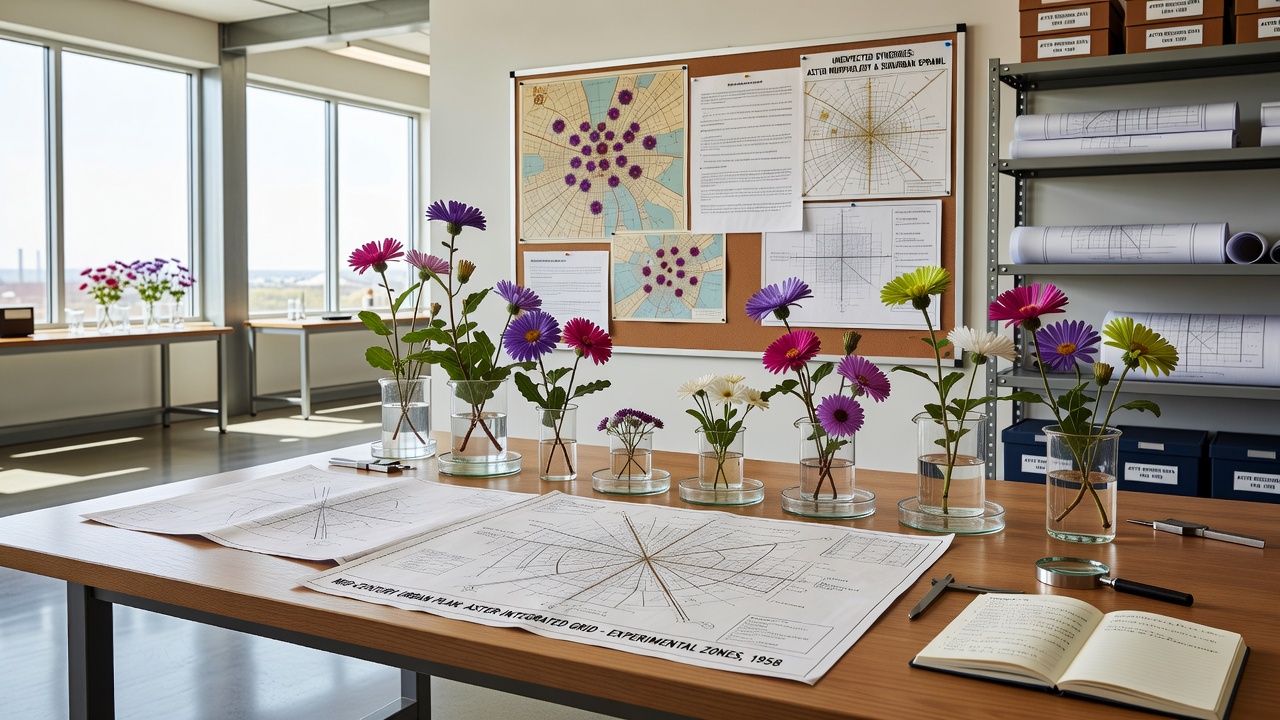
One study conducted in the Midwest examined how aster bed arrangements in demonstration gardens corresponded with circulation patterns in adjacent street grids, and the findings suggested that linear planting rows improved perceived orderliness in high-density areas. Meanwhile federal agencies compiled reports on vegetation performance in planned communities, and these documents sometimes referenced aster trials alongside infrastructure metrics such as drainage efficiency and pedestrian flow. Data from municipal archives indicate that several cities adopted planting templates derived from these experiments when designing neighborhood entryways and community centers during the 1950s and 1960s.
Archival Evidence and Cross-Disciplinary Links
University libraries hold correspondence between plant breeders and city planning offices that reveals shared interest in repeatable spatial modules, and these letters frequently discuss how aster growth patterns could model vegetation density for erosion control along new roadways. According to records preserved by the Library of Congress, several planning commissions requested seed samples from breeding programs to evaluate performance in public rights-of-way, and the resulting field notes contributed to updated specifications for street-tree and shrub combinations. In October 2026 the National Archives and Records Administration plans to open additional digitized collections that include inter-agency memos linking horticultural research with zoning ordinances, offering further material for scholars examining these intersections.
Canadian researchers working with similar post-war expansion challenges examined American aster data for comparative purposes, and their reports highlight parallels in how both countries used experimental plantings to test community-scale green infrastructure. European horticultural societies also exchanged cultivar lists with U.S. institutions during the same decades, and the shared emphasis on uniform plant spacing contributed to broader discussions about modular design principles that later appeared in international planning literature. Figures from agricultural census records show increased aster seed production coinciding with peak suburban construction years, suggesting market demand that tracked housing starts rather than purely ornamental trends.
Conclusion
Archival materials continue to surface connections between aster breeding records and mid-century urban planning documents, and these intersections provide concrete examples of how plant science data informed spatial organization in expanding American cities. The documented use of experimental cultivars in demonstration projects and the adoption of related spacing guidelines in municipal standards illustrate measurable overlaps between two fields that operated independently yet produced compatible outcomes. Ongoing digitization efforts scheduled through 2026 and beyond will likely yield additional primary sources that clarify the extent of these historical exchanges.